For decades, Anne Carson occupied a strange place in literature.
Serious readers knew her. Poets knew her. Classicists knew her. Writers admired her.
But she was never a household name.
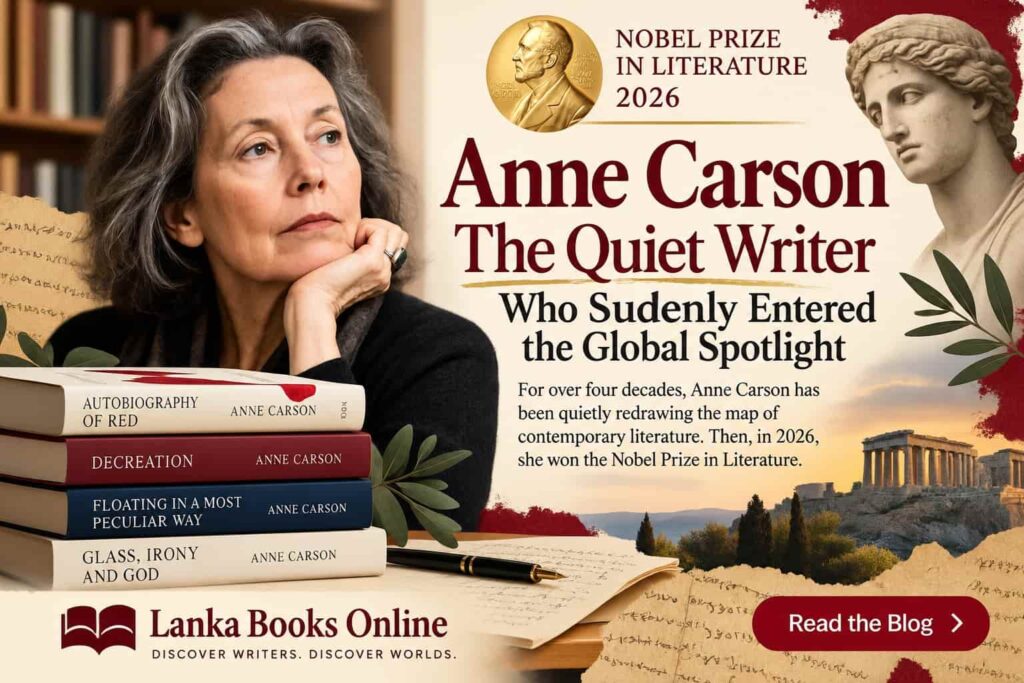
Then, on 8 October 2026, everything changed.
Anne Carson was awarded the **2026 Nobel Prize in Literature**, with the Swedish Academy recognising her for an inventive body of work that has created new literary forms through its dialogue with the classical tradition.
Suddenly, a writer who had spent more than forty years quietly working between poetry, translation, essays, classics and experimental fiction was standing in the brightest literary spotlight in the world.
And perhaps that is the most interesting thing about Anne Carson.
She never seemed to be writing for the spotlight.
A Writer Who Refused to Stay in One Box
Ask what kind of writer Anne Carson is and the answer quickly becomes complicated.
Poet?
Yes.
Essayist?
Yes.
Translator?
Certainly.
Classicist?
Absolutely.
Novelist?
Sometimes.
Her books often combine several of these forms at once.
Carson has spent much of her career taking the ancient world—Greek mythology, classical poetry, philosophy—and placing it beside modern experiences of love, loneliness, desire, grief and identity.
The result can feel unlike almost anything else on a bookshelf.
Her work moves between verse and prose, scholarship and imagination, ancient Greece and contemporary life.
When Thinking Becomes Part of the Story
Perhaps Carson’s greatest trick is that she makes **thinking itself interesting**.
Many writers tell us a story.
Carson often makes us watch a mind working.
An idea appears.
A fragment of Greek mythology enters.
A memory interrupts it.
A poem follows.
Then suddenly something written thousands of years ago seems intensely modern.
In Carson’s hands, scholarship and imagination are not opposites.
They feed each other.
That is particularly striking today, when academic writing and creative writing are often treated as completely separate worlds.
Carson has spent her career quietly ignoring that boundary.
Start With *Autobiography of Red*
For readers encountering Carson for the first time after the Nobel announcement, perhaps the most approachable place to begin is **Autobiography of Red**.
Published in 1998, it takes the ancient Greek figure Geryon and transforms his story into a modern work about love, identity and isolation.
But calling it a novel does not quite explain it.
It is written in verse.
It draws from mythology.
It feels contemporary.
At times it feels like poetry, fiction and classical scholarship have somehow been folded into the same book.
That is Anne Carson.
She makes categories feel unnecessary.
The Nobel Moment
When the Swedish Academy contacted Carson about the prize, she was reportedly in Iceland.
Her reaction was characteristically understated.
According to the Academy, she was surprised and told them she was there listening to the wind.
It is an almost perfect image.
While the literary world suddenly turned its attention towards Anne Carson, Anne Carson was listening to the wind.
For a writer whose career has never depended on literary celebrity, perhaps there could hardly be a more appropriate Nobel moment.
Why This Prize Matters to Readers
Every Nobel Prize in Literature creates a particular opportunity.
A writer whom millions of people may never have encountered suddenly becomes visible.
Bookshops display the books.
Readers search the name.
Old works return to bestseller lists.
And people ask the most important question:
**Where should I start?**
That is one of the pleasures of literary prizes.
They are not simply awards.
At their best, they are invitations.
The 2026 Nobel Prize invites readers to discover a writer who has spent decades exploring what literature can become when poetry, history, scholarship and imagination are allowed to mix freely.
Anne Carson may have entered the global spotlight overnight.
But the remarkable body of work behind that moment took a lifetime to create.
And for many readers, the discovery is only beginning.
**If you have never read Anne Carson, start with *Autobiography of Red* — and see where she takes you.**
— **Lanka Books Online**
*Discover writers. Discover worlds.*