

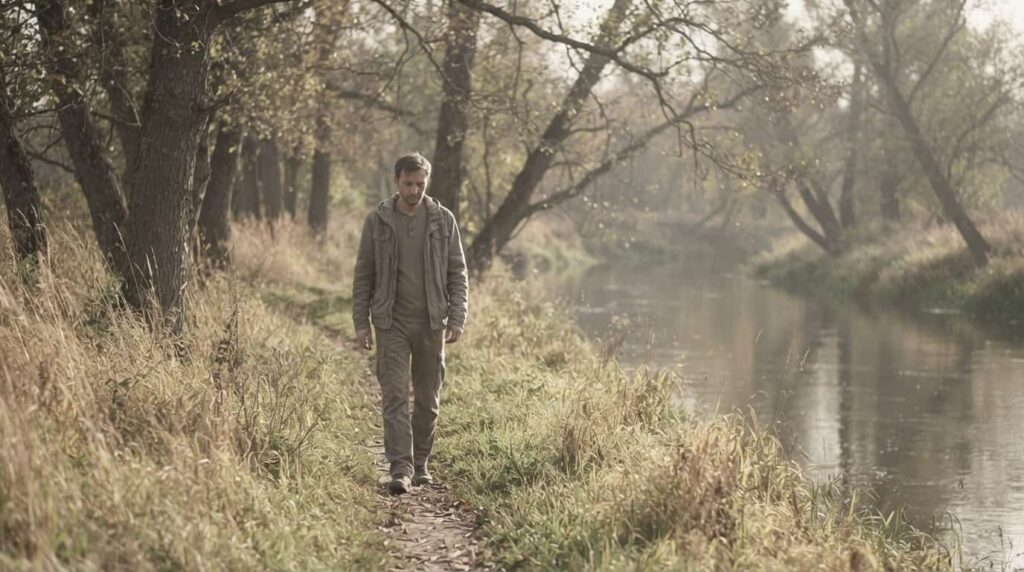
He had been walking for nearly an hour without really seeing anything.
The path followed the river, curving between old trees and patches of long grass. The afternoon was quiet. A few birds moved between the branches. Somewhere in the distance, a dog barked.
But his mind was somewhere else.
Yesterday’s mistake.
Tomorrow’s problem.
A conversation he wished had gone differently.
Money.
Age.
Work.
Family.
Regret.
Fear.
The same thoughts repeated themselves in different forms, like a wheel turning in mud.
Then, for no particular reason, he stopped.
The river was moving slowly in front of him.
Clouds drifted across the sky, and their reflections floated on the surface of the water.
For a few seconds he simply watched.
One cloud appeared.
Then changed shape.
Then disappeared downstream.
Another replaced it.
And suddenly a strange thought came to him.
The river was not worrying about where it had been.
The clouds were not worried about where they were going.
Only he was standing there, surrounded by life, while living almost entirely inside his thoughts.
That moment captures something close to the central message of one of the most influential modern spiritual books of our time: The Power of Now by Eckhart Tolle.
A Book About the Place We Rarely Live
Most of us believe we are living in the present.

Our bodies may be sitting at breakfast, driving to work, walking through a park or talking to someone we love.
Our minds, however, are often elsewhere.
We replay the past.
We anticipate the future.
We construct arguments that have not happened.
We worry about things that may never happen.
We remember old pain.
We imagine future success.
And somewhere inside all of this mental noise, the present moment quietly passes by.
Tolle’s central argument is surprisingly simple:
Life only ever happens now.
The past exists as memory.
The future exists as anticipation.
The only moment in which we can actually breathe, see, feel, act, love or change anything is the present one.
That sounds obvious.
But The Power of Now asks a much more uncomfortable question:
If that is true, why do we spend so little of our lives fully present?
Watching the River
Our man on the riverbank begins walking again.
But something has changed.
He looks more carefully at the water.
A fallen leaf lands on the surface and is carried downstream.
He thinks about something Tolle repeatedly returns to: our habit of identifying ourselves with thought.
Most people do not simply have thoughts.
We become our thoughts.
A fearful thought appears, and suddenly we are afraid.
An angry memory appears, and we become angry again.
A thought says, “My life is going badly,” and within seconds that sentence begins to feel like reality itself.
Tolle invites the reader to discover something very important:
You can observe your thoughts without becoming them.
Imagine sitting beside a river watching objects float past.
A branch.
A leaf.
A reflection.
A piece of grass.
You do not jump into the river and chase every object.
You simply see it pass.
Tolle suggests that thoughts can be treated in much the same way.
A thought appears.
You notice it.
You do not have to fight it.
You do not have to believe it.
You do not have to follow it.
You can allow it to pass.
That small shift — from being the thought to watching the thought — lies at the heart of the book.
The Voice Inside the Head
One of Tolle’s most memorable ideas concerns the constant internal voice many of us carry.
It comments on everything.
“This should not be happening.”
“I should have done better.”
“What will people think?”
“What if I fail?”
“Why did she say that?”
“What happens next?”
For many people, this commentary is so continuous that they barely notice it.
Tolle asks us to notice.
Not to silence the mind by force.
Not to declare war on thinking.
Simply to become aware of it.
The moment you can hear the voice in your head as a voice, rather than automatically believing everything it says, a small space opens.
And in that space there may be calm.
The Clouds in the Water
The man stops again.
The sky has become brighter.
The reflections of the clouds are now broken slightly by the moving current.
He watches one white shape dissolve into another.
Perhaps, he thinks, this is what emotions are like too.
They arrive.
They change.
They leave.
Yet when we are suffering, we often tell ourselves that the present feeling is permanent.
“I will always feel like this.”
“This pain will never end.”
“My life is ruined.”
But very little in human experience remains unchanged.
Tolle does not argue that suffering is imaginary.
His message is subtler.
He suggests that we often add a second layer of suffering to what is already happening.
There is the difficult situation itself.
And then there is the mind’s resistance to it:
“This must not be happening.”
“This is unbearable.”
“This should have been different.”
This resistance can amplify pain.
Tolle’s concept of acceptance does not mean passivity.
It does not mean accepting injustice or refusing to change difficult circumstances.
It means first acknowledging the reality of the present moment before deciding what to do about it.
You cannot respond clearly to reality while mentally insisting that reality should not exist.
 The Pain-Body
One of the more distinctive ideas in The Power of Now is what Tolle calls the pain-body.
He uses this term to describe accumulated emotional pain that can become activated in the present.
A small incident can sometimes produce a surprisingly large emotional reaction.
A careless remark.
A criticism.
A rejection.
A memory.
The reaction may appear to belong entirely to what just happened, but Tolle suggests that old unresolved emotional patterns may also be involved.
Whether readers accept the term literally or treat it as a metaphor, the practical idea is useful:
Sometimes we are reacting not only to the present situation, but also to the emotional history we bring into it.
Awareness can interrupt that cycle.
Eckhart Tolle was born Ulrich Leonard Tölle in Germany in 1948.
He later lived and studied in England and has described experiencing a period of intense anxiety and depression during his youth.
According to Tolle’s own account, at the age of twenty-nine he went through a profound inner transformation.
One night, overwhelmed by psychological suffering, he began questioning the nature of the “self” that was suffering.
That experience became the foundation for the teachings he would later develop.
For several years he lived relatively quietly, eventually becoming a spiritual teacher.
The Power of Now was first published in the late 1990s and gradually became an international bestseller.
His later books include A New Earth, Stillness Speaks, and Practicing the Power of Now.
Tolle’s teaching draws from several spiritual traditions, although he presents his ideas in language designed to reach readers beyond any single religion.
Readers may hear echoes of Buddhism, Christianity, mysticism, Zen and other contemplative traditions.
But Tolle’s central concern is less about doctrine than experience.
He repeatedly asks the reader to stop thinking about presence and actually experience it.
Part of the answer may be timing.
Modern life is filled with mental noise.
Notifications.
Deadlines.
News.
Emails.
Social media.
Financial pressure.
Career anxiety.
Family responsibilities.
Constant comparison.
People have access to more information than any previous generation, yet many feel increasingly distracted and mentally exhausted.
Into that environment comes a book saying:
You do not have to solve your entire life right now.
Return to this breath.
This room.
This step.
This moment.
For millions of readers, that message has been powerful.
The book became a worldwide bestseller and gained enormous attention after being recommended by influential figures including Oprah Winfrey. Tolle himself became one of the best-known contemporary spiritual teachers.
But the book’s continued popularity probably comes from something deeper than celebrity endorsement.
Its central exercise costs nothing.
It requires no pilgrimage.
No equipment.
No complicated philosophy.
You can practise it while washing a cup.
Walking to the bus stop.
Listening to your child.
Sitting in a hospital waiting room.
Standing beside a river.
Simply notice where you are.

This is an important misunderstanding.
Tolle is not saying that we should stop planning.
The man beside the river may still need to think about tomorrow.
He may need to pay bills.
Make appointments.
Solve problems.
Prepare for work.
Care for his family.
Planning happens in the present too.
The difference is between using thought and being trapped inside thought.
You can make a plan for next week for ten minutes.
Then return to the life happening in front of you.
The problem begins when next week occupies your mind for the entire day.
Our walker reaches a small wooden bench.
He sits down.
For perhaps the first time that afternoon, he deliberately pays attention.
He hears the river.
He feels the weight of his body against the bench.
He notices cool air touching his face.
He sees sunlight moving through leaves.
Nothing spectacular happens.
There is no mystical vision.
No voice from the sky.
His problems have not disappeared.
But for a moment, they are not the whole universe.
There is simply life.
And perhaps this is the great attraction of Tolle’s message.
We spend years waiting for life to become better.
When I earn more.
When this dispute ends.
When the children grow up.
When I retire.
When I recover.
When I find the right person.
When things become easier.
Then I will live.
The Power of Now asks:
Why You Should Read The Power of Now
This is not a book everyone will agree with.
Some readers may find parts repetitive.
Others may question some of Tolle’s spiritual language or psychological concepts.
And it should not be treated as a replacement for medical or psychological care where those are needed.
But agreement is not necessary for a book to be valuable.
A good book can give us a new question.
And The Power of Now gives us an important one:
Read this book slowly.
Do not rush through it as though finishing the final page is the achievement.
Put it down occasionally.
Look out of the window.
Take a walk.
Watch a river if you can.
Look at the clouds.
Listen to the ordinary sounds around you.
Then notice what your mind is doing.
You may discover that Tolle’s most important idea is not hidden somewhere in the book.
It is already happening around you.
The River Keeps Moving
The man finally turns toward home.
The problems he brought with him are still there.
There will still be decisions tomorrow.
There may still be difficult conversations.
Nothing magical has happened.
And yet something small has changed.
Earlier, he walked beside the river without seeing it because his mind was filled with yesterday and tomorrow.
Now he notices the evening light touching the water.
He notices the clouds.
He notices his footsteps.
For a few minutes, he is no longer waiting for life to begin.
He is inside it.
The river continues toward a destination it cannot see.
The clouds continue across a sky they cannot keep.
And the man finally understands the quiet proposition at the centre of Eckhart Tolle’s remarkable book:
You cannot live yesterday again.
You cannot live tomorrow yet.
But this moment — this one — is yours.
Perhaps that is why The Power of Now continues to find readers.
It does not promise us another life.
It asks us to notice the one we already have.