Cinnamon smells sweet. But Sri Lankan historian Nira Wickramasinghe has discovered a rather bitter story beneath its fragrant bark
We Sri Lankans are proud of our cinnamon. We call it *Ceylon Cinnamon*, celebrate its quality and export it across the world. A little cinnamon in a cup of tea or a delicious curry is enough to remind us why it has been treasured for centuries.
But have you ever wondered about the people who peeled that cinnamon? How they lived, what they earned, and whether they had the freedom to choose their work?
Most histories of cinnamon tell us about adventurous European traders, Portuguese conquerors, Dutch merchants and British colonial administrators. They explain how a valuable spice helped create fortunes and expand empires.
Professor Nira Wickramasinghe looks at the same history through a very different window.
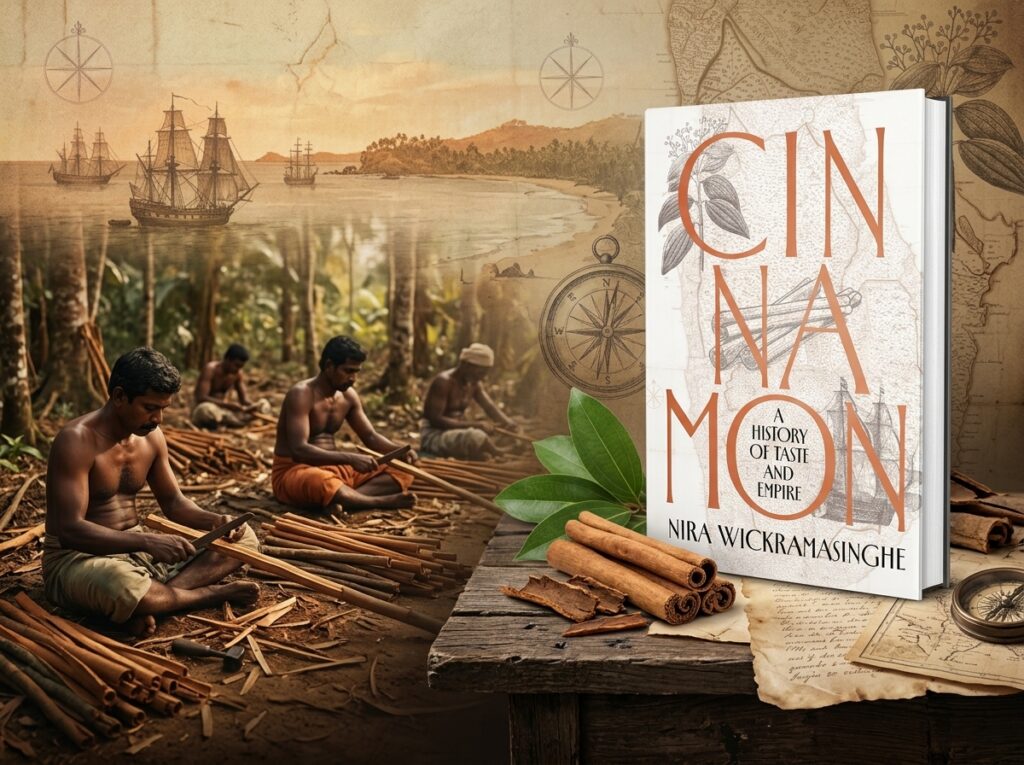
In her new book, *Cinnamon: A History of Taste and Empire*, published by Scribe, she takes readers beyond the fragrance, the trade routes and the imperial rivalries into the lives of the ordinary people who made the cinnamon trade possible.
And suddenly, the sweetest of spices begins to taste rather bitter.
### The historian’s unusual perspective
Wickramasinghe, a distinguished Sri Lankan historian at Leiden University in the Netherlands, is particularly interested in the people whom conventional histories often leave in the background.
Her approach reminds us that history is not simply about what kings conquered, what merchants sold or what colonial governments achieved.
It is also about how ordinary people lived under the social arrangements that made those achievements possible.
Consider Sri Lanka’s traditional cinnamon peelers.
Their specialised knowledge was essential to an immensely profitable international trade. Yet generations of these workers were tied to inherited obligations and systems of colonial control. They were neither simply slaves nor genuinely free workers.
Their labour produced a luxury enjoyed in distant households, while their own lives were shaped by restrictions, obligations and inequalities.
Some even rebelled against these arrangements.
**Here is the fascinating sociological twist: the value of cinnamon was not determined by its fragrance alone. It was also shaped by the social organisation of the people who produced it.**
The world admired the spice. But how much did it know about the society behind it?
### A small spice, a very large story
Wickramasinghe takes us from ancient Egypt to Mughal kitchens, across oceans and through centuries of imperial competition.
Cinnamon appears as medicine, luxury, culinary delight and commercial treasure.
But running through these adventures is a deeper question about power: who controls a valuable commodity, who performs the labour, and who enjoys the rewards?
It is a question that remains surprisingly relevant in our world of global brands, agricultural exports and international supply chains.
We know the price of a product. We rarely know the social history concealed within it.
### Why Sri Lankan readers should discover this book
*Cinnamon* encourages us to look at a familiar part of our national heritage with fresh eyes.
It doesn’t ask us to stop being proud of Ceylon Cinnamon. Rather, it encourages us to recognise another dimension of that pride: the skill, knowledge, struggles and experiences of the people who produced it.
That is what makes Wickramasinghe’s perspective so engaging. She shows us that even an everyday kitchen ingredient can open the door to questions about society, inequality and human freedom.
**Next time you stir a cinnamon stick into your tea, you may remember something more than its wonderful aroma.**
Because cinnamon is sweet to the senses. But, as this book reveals, its social history can be decidedly bitter.
Cinnamon: A History of Taste and Empire*
Author:** Nira Wickramasinghe
Publisher:** Scribe Publications
*Publication:** November 2026
Format:** Hardback, 352 pages
UK price:** £25.00
*From Lanka Books Online — bringing fascinating books, fresh perspectives and the pleasure of reading closer to Sri Lankan readers.*
A little piece of a British bookshop, right here in Sri Lanka