Wars are usually written through battles, leaders and casualty figures. V. V. Ganeshananthan chooses a different doorway: what war does to a family, a friendship, and a young woman’s plan to become a doctor.
Brotherless Night, published in 2023, won both the 2024 Women’s Prize for Fiction and the 2024 Carol Shields Prize. But for Sri Lankan readers, the prizes are the least interesting thing about it. What matters is that it tells part of our history through the people who had to live inside it — and that it has not been read the same way by everyone who has lived inside it.
 Who Is V. V. Ganeshananthan?
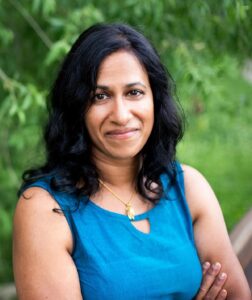
Ganeshananthan, known as Sugi, is a novelist, essayist and journalist of Sri Lankan Tamil heritage. Her first novel, Love Marriage, worked through family, migration and the political history of the island. Brotherless Night is the book that established her as one of the most consequential writers connected to Sri Lanka currently working in English — not because it is comfortable, but because of where it chooses to stand.
A Family in Jaffna
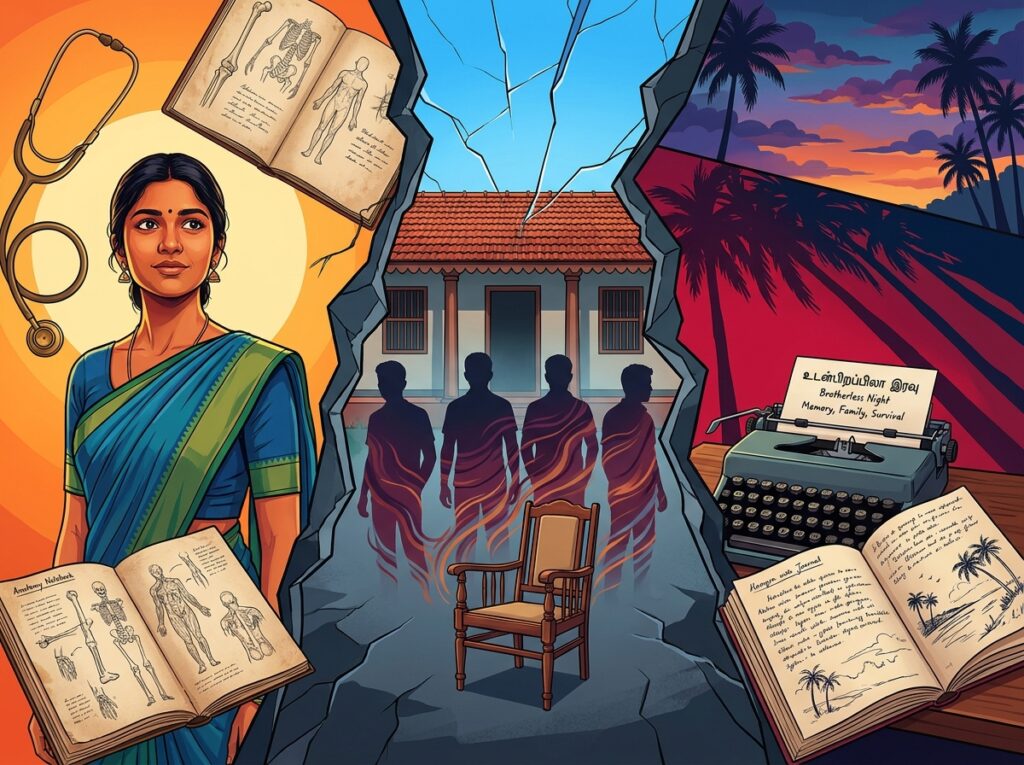
Sashikala Kulenthiren is sixteen, growing up in Jaffna with her parents and four brothers, hoping to follow her grandfather into medicine. The novel opens in this ordinary ambition and then dismantles it, one brother at a time: Niranjan is killed in the anti-Tamil violence of 1983; Dayalan and Seelan are drawn into the Tamil Tigers; her closest friend and eventual love, K, a fellow medical student, is recruited alongside them.
The war does not arrive as a headline. It arrives as an empty seat, a burned car, a brother who comes home speaking a language his sister no longer recognises.
Making Sashi a medical student is the book’s central structural choice, and it earns its weight in a specific way. K recruits her to work as a medic at a Tiger field clinic — which means the novel doesn’t ask its “can medicine stay neutral in war” question in the abstract. It puts Sashi in a clinic run by the same organisation that is radicalising her brothers, treating wounded fighters while her own convictions are still forming. When the Tigers kill one of her teachers, and Indian peacekeeping soldiers arrive and commit further violence against the civilians they were meant to protect, Sashi’s position becomes untenable from both directions at once. She is later recruited by her anatomy professor, Anjali — herself secretly documenting human rights violations — into an even more dangerous kind of witnessing: not treating the wounded, but recording who wounded them and why the record itself is being suppressed.
That is the novel’s real argument. Neutrality isn’t a position Sashi holds and then loses. It’s a position that was never available to her — the book uses her medical training to prove that, scene by scene, rather than asking the reader to take it on faith.
Ganeshananthan does not romanticise the Tigers to make the case against state violence. Sashi comes to see her brother Dayalan as complicit in the movement’s own atrocities — its killing of rival Tamil militants, its crushing of internal dissent — at the same time as she is living through the aftermath of the 1983 pogrom that made that movement possible in the first place. The novel holds both of those truths without letting either one cancel the other out. That refusal to pick a side, applied evenly to the Sri Lankan state, the Tigers, and the Indian peacekeeping force in turn, is what critics have most consistently pointed to as its achievement — Omar El Akkad, reviewing it for the New York Times, singled out its resistance to the flattening word “terrorist” as the book’s moral centre.
But it’s worth saying plainly that this achievement is contested, not unanimous, among Tamil readers — and the disagreement is itself worth sitting with rather than smoothing over. Writing in the Tamil Guardian, one reader argued that the novel’s version of Jaffna is an upper-middle-class one, and that the war it depicts is filtered through a family with the resources to survive, migrate and eventually write about it — a “parallel Jaffna,” in that critic’s phrase, where caste and class are largely absent from a childhood that for many Tamils would have included both from the start. That’s a genuine fault line: a novel can be scrupulously fair between the state, the Tigers, and the IPKF, and still be telling the story from one class position within the Tamil community and not the whole of it. Other Tamil readers — including some who lived through the same Jaffna in the same years — have described the book as the first time they’ve recognised their own adolescence on the page at all, disagreements about class notwithstanding. Both responses can be true, and a Sri Lankan readership deserves to know that the book was received as an argument, not just as a verdict.

The title does double work. Sashi loses her brothers — to riots, to recruitment, to death, to a war that never returns them to who they were. But it also names something larger: a generation of Tamil families with young men killed, disappeared, conscripted or exiled, and the mothers, sisters and wives who kept living in the rooms they left behind. The novel’s late turn — toward Sashi’s own work as a documentarian, and toward a present-day frame in New York, in 2009 — insists that the brotherless night didn’t end when the war did. It just changed address.
Sashi’s story is specific: Jaffna, 1980s, a war with its own names and dates. But the pattern — young people pulled into armed politics, a family divided by ideology, a person trained to heal caught inside a machine built to harm, a history controlled by whoever survives to write it down — travels well past the island. That’s not a flaw in the book’s specificity; it’s what specificity, done well, actually produces.
Ganeshananthan isn’t presenting Sri Lanka’s war to the world so much as refusing the version of it that fits in a headline. She recovers the ordinary people trapped between the labels of hero and traitor. Whether she recovers all of them — whether Sashi’s Jaffna is wide enough to hold every Jaffna — is a question her own Tamil readers are still arguing about, and that argument is part of what makes the book worth reading closely rather than simply praising.
That, probably, is the more honest thing literature can do: not settle the argument, but make it possible to have.