
A child opens a book. A forest appears. Somewhere inside it, a wolf is waiting. A forgotten door leads to an enchanted room. A small child must face a giant.
Fairy tales may be old, but the needs they answer are not.
When children watch a video, the castle, dragon and forest arrive already designed. Reading asks children to create those worlds for themselves.
No two children imagine Cinderella’s carriage or Jack’s beanstalk in exactly the same way. This private act of creation develops imagination, creativity and problem-solving.
Childhood contains fear: separation, loneliness, strangers, punishment and the possibility of losing adult protection. Children may feel these anxieties before they have words to explain them.
The dark forest becomes uncertainty. The wolf becomes danger. The locked tower becomes isolation.
Because these fears exist inside a story, children can approach them safely. They can close the book, ask questions and return when ready. Most importantly, they discover that frightening experiences can be faced and survived.
Fairy-tale heroes are rarely powerful at the beginning. They are often the youngest child, a neglected sister, a poor woodcutter or someone nobody takes seriously.
Yet Jack confronts a giant. Hansel and Gretel escape the witch. Cinderella survives cruelty without abandoning hope.
Their message is simple but powerful:
You may be small, but you are not helpless.
In a world largely controlled by adults, children need to hear that.
Fairy tales present kindness and cruelty, loyalty and betrayal, courage and cowardice. They allow children and parents to ask:
Why did the stranger lie?
Should the character have kept that promise?
Could the villain have chosen differently?
What would you have done?
Children do not need to accept every old moral without question. Discussing and challenging a story helps them develop judgement.
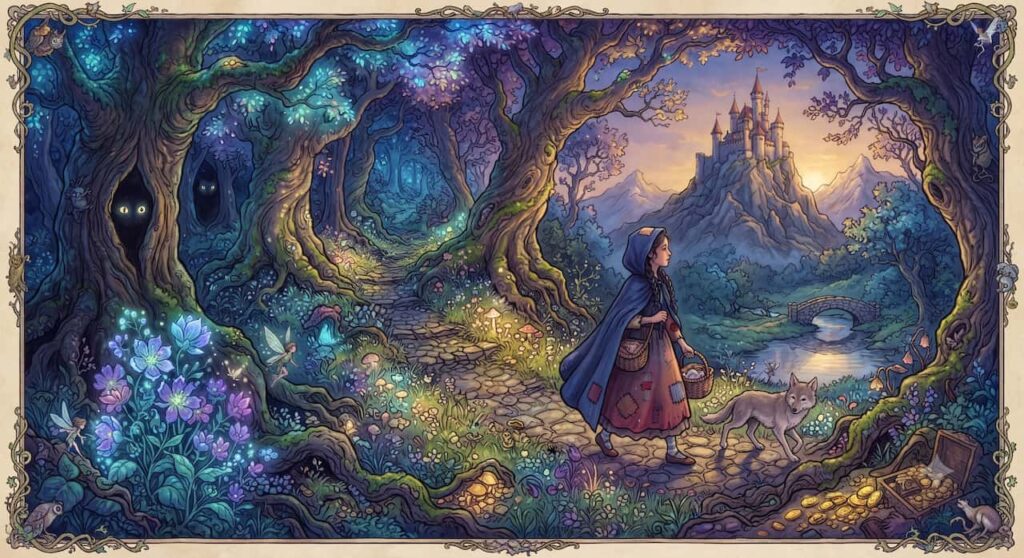
“Once upon a time” immediately tells a child that something special is beginning.
Fairy tales contain memorable phrases, repetition, vivid descriptions and clear sequences of cause and effect. Children often request the same story repeatedly, gradually absorbing its vocabulary and sentence patterns.
Familiar tales are especially useful for children learning English. If they already know Cinderella’s story, they can use that knowledge to understand unfamiliar English words.
A parent may read a story once told by a grandparent. A Sri Lankan child can enter a European forest, an Arabian palace or a South Asian kingdom—and compare those places with stories from our own traditions.
Across cultures, similar characters return: clever animals, lost children, magical helpers and ordinary people defeating powerful enemies.
The settings change, but the questions remain:
Who can be trusted? What makes someone brave? Can injustice be overcome? Where do we belong?
Traditional stories can include death, abandonment and cruel punishment. Age and sensitivity matter. A version suitable for an eight-year-old may disturb a four-year-old.
But removing every danger also removes the emotional journey. A carefully selected fairy tale lets a child experience fear while sitting beside someone they trust—and discover that the story continues beyond the frightening moment.
Parents can choose gentle editions, read together and encourage questions.
Children can enjoy classic fairy tales while also reading modern retellings:
What if the princess rescues herself?
What if the monster is misunderstood?
What if the wolf tells the story?
Comparing versions teaches children that stories can be questioned, reimagined and retold.
Building a children’s library need not be expensive. Pre-loved books make it possible to offer children greater variety at an affordable price.
Lanka Books Online carries fairy tales, illustrated classics, princess adventures, animal stories and imaginative children’s books. Because the pre-loved collection continually changes, families can find familiar favourites alongside unexpected treasures.
A book that once delighted one child is ready to begin again in another home.
Explore the children’s collection at Lanka Books Online and let your child choose the door to the next adventure.
Fairy tales do not teach children that dragons exist. Children already know the world contains frightening things.
Fairy tales teach them that dragons can be faced.