

characters leave us as soon as the book is finished.
But Gaspar didn’t.
I thought about him for days after finishing Mariana Enríquez’s novel Our Share of Night. Not where the author left him—but where he is now.
Has he recovered? Can he sleep? Has he finally found someone he can trust?
If Gaspar had a phone number, I think I would call him.
I wouldn’t ask him first about ghosts, mysterious rituals, or the strange house that swallowed people. I would ask a much simpler question.
“Gaspar, are you okay?”
That’s where Mariana Enríquez’s strength lies. She writes gothic horror, but her characters don’t seem like fictional figures created solely to scare us. They feel like people we once knew—people who survived something terrible but can’t find the words to explain what happened to them.
Our Share of Night begins in Argentina in 1981.
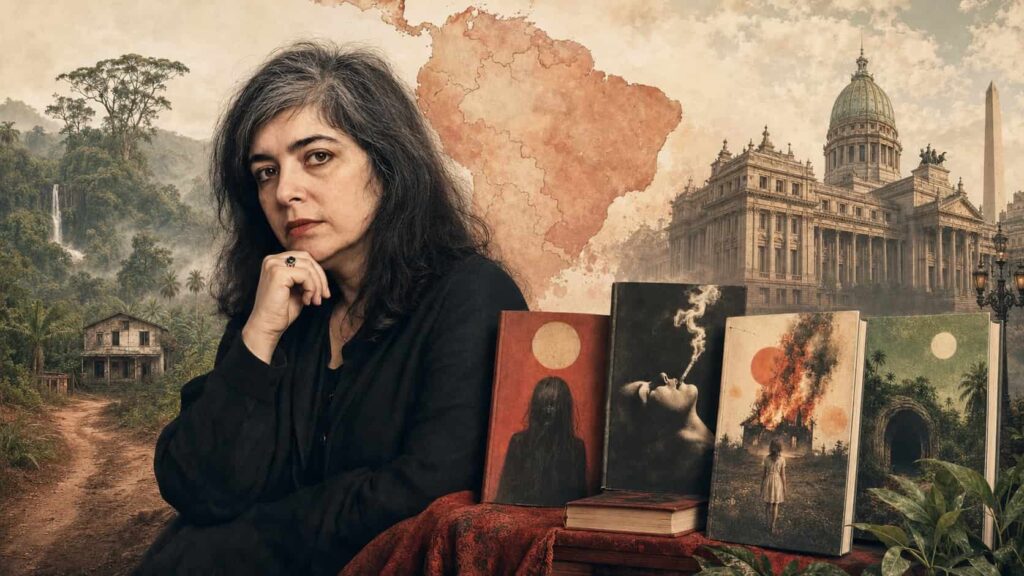
Juan Peterson, recently widowed, sets out on a journey with his six-year-old son, Gaspar. They leave Buenos Aires and head for the northern province of Misiones, a land of red sand, dense forests, unbearable heat, and towering waterfalls.
At first, this seems like a journey of grief between a father and son.
Gaspar’s mother, Rosario, has died in a suspicious accident. Juan is physically ill. He is mentally shattered. Gaspar tries to understand why his mother disappeared, and why his father has become such an unpredictable and frightening person.
But Juan is no ordinary father.
He is a medium—a man who can open a portal through his body to a terrifying supernatural force called “the Darkness.”
A secret organization called “The Order” uses Juan for its rituals. Its members are not powerless villagers or terrified believers. They belong to families with vast wealth, land, political connections, and influence that stretches from Argentina to Europe.
They believe that through the Darkness they can achieve a kind of immortality.
The Darkness is mysterious.
But the machinery that operates around it is painfully human.
Argentina and Sri Lanka are separated by oceans, languages, and very different histories. It is not right to simplify the experiences of the two countries into a single story.
But Sri Lankan readers can identify with some of the emotional terrain of this novel.
We know what it means to have public history enter private homes. We also know that political violence does not end once an official declaration is made that a conflict is over.
It lives on in missing relatives, in frightened parents, in guarded conversations, and in children who inherit memories they did not create.
Enríquez understands that trauma is transmitted from one generation to the next not only through stories but also through silence.
Wealthy families inherit power.
The children of the disappeared inherit unanswered questions.
This novel asks us again and again:
What does one generation leave to the next?
Land? Money? The family name?
Or fear, guilt, and unfinished history?
She uses gothic horror, body horror, haunted houses, and mysterious rituals to show how violence corrupts families and the land.
Her mystical world does not lighten the weight of political reality. It does so by tearing down the wall that has hidden political truth.
García Márquez often made history into a myth.
Enríquez makes history into a wound that has learned to speak.
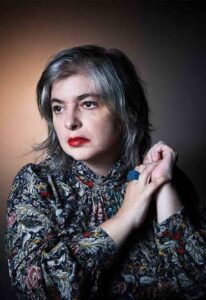 The writer behind the darkness
is Mariana Enríquez, an Argentine novelist, journalist, and short story writer.
Her work repeatedly explores the spectres created by authoritarian rule, urban poverty, violence against women, wounded bodies, abandoned places, and social inequality.
Her collection of short stories The Dangers of Smoking in Bed was shortlisted for the 2021 International Booker Prize. Her other notable works include Things We Lost in the Fire and A Sunny Place for Shady People.
Our Share of Night, first published in Spanish in 2019, was translated into English by Megan McDowell. It won the prestigious Premio Herralde de Novela. Her growing international recognition is documented on the websites of The Booker Prizes and the Dublin Literary Award.
But her power cannot be explained by awards alone.
Her excellence is that the supernatural world never lets us escape from reality. Every ritual takes us back to class power. Every disappearance recalls political terror. Every haunted child carries something within them that adults have refused to face.
Our Share of Night is a long, disturbing and at times very violent novel. It depicts abuse, addiction, ritual cruelty and the exploitation of children. So it may not be suitable for every reader.
But it is also a deeply emotional novel about a father who tries—imperfectly, violently and desperately—to prevent his son from inheriting his destiny.
When I closed the book, the first thing I thought about was not darkness or order.
I thought about Gaspar.
Somewhere in my imagination, he is still standing near that impossible house. Trying to decide whether to enter it or not. Carrying with him the questions of the dead. He struggles to separate his life from the history he holds within him.
I wanted to talk to him on the phone.
Perhaps that is one way to measure a great novelist. She creates a person who never lived. She places him in a country thousands of miles away. And then makes us wonder if he ever made it home safely.
Mariana Enríquez may be becoming the new international face of South American literature.
But she is not just another literary star.
She is a writer who goes into the darkness of history and returns with people we will never forget.